
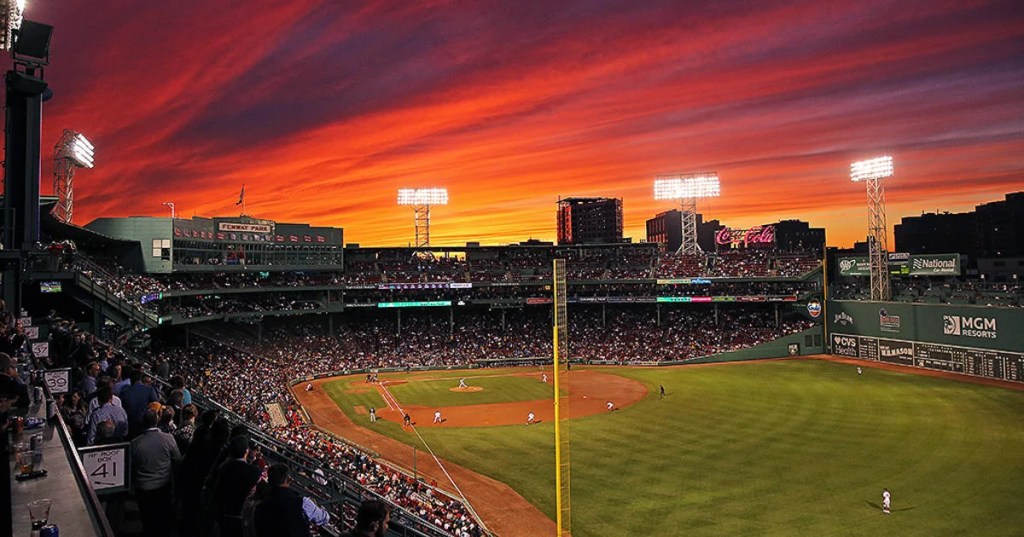
Baseball’s soul is supposed to thrive in its stadiums—some deliver raw grit and timeless glory, while others are soulless cash grabs begging for a wrecking ball. I’ve ranked all 30 MLB stadiums, from the divine to the dismal, using hard data: seating capacity, opening dates, World Series wins, unique quirks, and that unfiltered, visceral feel of the place. This is the no-holds-barred truth about MLB ballparks, dripping with venom and reverence—strap in for the ride.
Best Baseball Stadiums to Visit
1. Fenway Park (Boston Red Sox)
- Capacity: 37,755
- Opened: April 20, 1912
Fenway Park, home of the Boston Red Sox, is the oldest MLB stadium still in use today—a 113-year-old warhorse that’s weathered baseball history and refuses to bow out. The Green Monster, a 37-foot-high left-field wall just 310 feet from home, turns lazy flies into doubles (1.093 park factor) and homers into singles, while Pesky’s Pole at 302 feet down the right-field line dishes out cheap dingers like candy at a parade. This MLB stadium has hosted 11 World Series from 1912 to 2018, with six Red Sox victories, and its warped layout—think the 420-foot center-field triangle—has spawned 18 batting champs since WWII, from Ted Williams to Mookie Betts. Added to the National Register of Historic Places in 2012, Fenway’s got cramped seats, tiny foul territory, and obstructed sightlines everywhere—but that’s the magic. It’s not comfy; it’s alive, a fossil breathing fire in the heart of Boston. You wanted it #1, and its bloody legacy demands it.
2. Wrigley Field (Chicago Cubs)
- Capacity: 41,649
- Opened: April 23, 1914
Wrigley Field, home to the Chicago Cubs, rolled in two years after Fenway—a 111-year-old shrine known for its ivy-covered outfield walls, planted in 1937, that snag liners like a spider’s web. The hand-turned scoreboard laughs at tech, the red marquee screams 1914, and Lake Michigan winds juice a 1.015 run factor. Built for the Federal League’s Chi-Feds, the Cubs took over in 1916, enduring a 108-year title drought until the 2016 World Series—Wrigley’s first since 1945—broke the curse. Rooftop bleachers across Waveland Avenue, legalized in 2004, add over 4,000 seats, keeping it gritty. No roof coddles fans here—just history, weathered and real, a whisper shy of Fenway’s chaos.
3. PNC Park (Pittsburgh Pirates)
- Capacity: 38,747
- Opened: March 31, 2001
PNC Park, the Pittsburgh Pirates’ gem, proves a stadium doesn’t need a century to shine. The Pittsburgh skyline dazzles beyond center, framed by the Roberto Clemente Bridge—closed for fans on game days like a Steel City ritual. The right-field wall, a mere 325 feet and 6 feet high, has swallowed 46 splash homers into the Allegheny River by 2023, starting with Barry Bonds. At 410 feet to center, its retro limestone keeps every seat under 88 feet high, blending modern polish with intimacy. No World Series yet, but the Pirates’ 2013-15 playoff runs and USA Today’s 2024 readers’ poll naming it #1 cement its timeless grit.
4. Oracle Park (San Francisco Giants)
- Capacity: 41,915
- Opened: March 31, 2000
Oracle Park, home to the San Francisco Giants, sits on the San Francisco Bay with a view of the San Francisco skyline that’s pure West Coast swagger. McCovey Cove beyond the 309-foot right-field line has claimed 165 splash homers by 2024—Bonds owns 35—while the 24-foot “Archway” at 368 feet in right-center dares triples, balancing a 0.944 run factor. It hosted the 2002 World Series (lost to the Angels) and 2007 All-Star Game, with garlic fries and foggy vibes defining it. Kayaks chase homers in the water, brick arches nod to the past—no retractable roof here, just defiance built to endure.
5. Dodger Stadium (Los Angeles Dodgers)
- Capacity: 56,000
- Opened: April 10, 1962
Dodger Stadium, the Los Angeles Dodgers’ titan, is MLB’s biggest at 56,000 seats—third-oldest after Fenway and Wrigley—and looms over Chavez Ravine with ‘60s LA cool in its hexagon roofs and pastel hues. Fair dimensions (330-foot corners, 395-foot center, 1.002 run factor) have hosted 10 World Series from 1963 to 2020, with five Dodger wins from Koufax to Kershaw, all for a lean $23 million build. No retractable nonsense—just palm trees and Hollywood sprawl. Traffic’s a nightmare, and 16,000 parking spots clog fast, but this stadium dominates without trying.
6. Yankee Stadium (New York Yankees)
- Capacity: 46,537
- Opened: April 2, 2009
Yankee Stadium, the New York Yankees’ billion-dollar beast, cost $2.3 billion with a 318-foot right-field porch pumping lefty homers (1.208 park factor) and a tight 314-foot left line. It won the 2009 World Series fresh out of the gate, seats 46,537, and Monument Park hides behind the 408-foot center wall—less soulful than the 1923 original. Marble concourses and 1,300+ HD screens polish it, drawing 4 million fans yearly. It’s the House That Cash Built—gravitas intact, grit scrubbed clean.
7. Camden Yards (Baltimore Orioles)
- Capacity: 44,970
- Opened: April 6, 1992
Oriole Park at Camden Yards sparked the retro-ballpark craze, seating 44,970 with the B&O Warehouse looming 432 feet past right field. The 333-foot left line and 25-foot wall feed lefty power (1.060 run factor), hosting the 1993 All-Star Game and 2014 ALCS. Steel beams and brick echo Eutaw Street’s 1890s roots—Cal Ripken’s streak ended here in ‘95. No World Series, but Baltimore’s pulse keeps it a champ.
8. Petco Park (San Diego Padres)
- Capacity: 40,209
- Opened: April 8, 2004
Petco Park, the San Diego Padres’ downtown San Diego haven, seats 40,209 with the Western Metal Supply Co. building in left field at 336 feet—a 1909 relic baked into the design. Center’s 396 feet (0.941 run factor) hosted the 2022 NLCS—tacos rule, the grassy hill draws families, and 72°F weather shines. No World Series, but it’s got guts.
9. Chase Field (Phoenix Diamondbacks)
- Capacity: 48,405
- Opened: March 31, 1998
Chase Field, the Diamondbacks’ desert oddity, boasts MLB’s first outfield pool at 413 feet and a retractable roof beating Phoenix’s 110°F heat. Corners at 330 feet juice homers (1.074 run factor), and the 2001 World Series clincher off Rivera shines—$354 million built quirks like a dirt strip and a 25-foot center wall. It’s weirdly great, not just a heat shield.
10. T-Mobile Park (Seattle Mariners)
- Capacity: 47,929
- Opened: July 15, 1999
T-Mobile Park fights Seattle’s rain with a retractable roof—open 70% of games—seating 47,929 with Puget Sound peeking out. At 331 feet to left and 405 to center (0.970 run factor), Ichiro’s 262-hit 2004 season thrived—no World Series, but the 1995 ALDS comeback vs. the Yankees echoes. A maritime warrior with muscle.
11. Busch Stadium (St. Louis Cardinals)
- Capacity: 45,494
- Opened: April 4, 2006
Busch Stadium sits under the Gateway Arch, seating 45,494 in Cardinal red—336 feet to left, 400 to center (0.995 run factor). It won the 2006 and 2011 World Series—Yadi’s clutch DNA stains it—while brick retro and “Ballpark Village” sprawl nearby. Stan Musial’s statue guards it—baseball lives here.
12. Target Field (Minnesota Twins)
- Capacity: 38,544
- Opened: April 12, 2010
Target Field’s modern gleam seats 38,544 with Minneapolis’s skyline and a limestone facade—339-foot left, 411-foot center (0.987 run factor). A “living” batter’s eye of plants quirks it up—307 team homers in 2019 flexed power—but no World Series scars keep it tame in Minnesota’s brutal winters.
13. Comerica Park (Detroit Tigers)
- Capacity: 41,083
- Opened: April 11, 2000
Comerica Park roars with tiger statues in Detroit—345 feet to left, 420 to center (0.976 run factor). It lost the 2006 and 2012 World Series—Motor City grit meets half-baked retro with a Ferris wheel and 110-foot scoreboard. It’s trying, not triumphing.
14. Citi Field (New York Mets)
- Capacity: 41,922
- Opened: April 13, 2009
Citi Field, the New York Mets’ home, carries Shea’s ghost with the Home Run Apple—335 feet left, 408 feet center (0.950 run factor). The 2015 World Series loss to the Royals stings—$850 million built a solid Queens successor with Ebbets Field nods.
15. Coors Field (Colorado Rockies)
- Capacity: 46,897
- Opened: April 26, 1995
Coors Field’s mile-high 5,280 feet pumps homers (1.156 run factor)—350-foot corners, 415-foot center—and purple seats mark altitude. It lost the 2007 World Series—pitchers sob, stats lie, and it coasts on thin air.
16. Minute Maid Park (Houston Astros)
- Capacity: 41,168
- Opened: March 30, 2000
Minute Maid Park, the Astros’ den, seats 41,168 under a retractable roof—315-foot Crawford Boxes juice homers (1.053 run factor). It won the 2017 and 2022 World Series—ditching Tal’s Hill in ‘17 added sanity, but it’s bland despite rings.
17. Progressive Field (Cleveland Guardians)
- Capacity: 34,830
- Opened: April 2, 1994
Progressive Field’s MLB’s smallest at 34,830—325-foot corners, 410-foot center (0.982 run factor). It lost the 2016 and ‘97 World Series—$39 million in ‘14 upgrades can’t sharpen its fading edge.
18. Citizens Bank Park (Philadelphia Phillies)
- Capacity: 42,901
- Opened: April 3, 2004
Citizens Bank Park packs 42,901—330-foot corners, 401-foot center (1.072 run factor)—and won the 2008 World Series, lost in 2022. Philly fans hurl batteries—it’s their edge in a B-tier retro shell.
19. Great American Ball Park (Cincinnati Reds)
- Capacity: 43,500
- Opened: March 31, 2003
Great American Ball Park sits 500 feet from the Ohio River—328 feet left, 404 feet center (1.068 run factor). Smokestacks mimic steamboats—no World Series, just Pete Rose’s hit #4,192 plaque from ‘85.
20. American Family Field (Milwaukee Brewers)
- Capacity: 41,900
- Opened: March 30, 2001
American Family Field’s fan-shaped retractable roof covers 41,900—344 feet left, 400 feet center (0.999 run factor). Sausage races and Bernie’s Slide entertain—no World Series, just a 2018 NLCS peak.
21. Truist Park (Atlanta Braves)
- Capacity: 41,084
- Opened: April 14, 2017
Truist Park seats 41,084 amid suburban sprawl—335 feet left, 400 feet center (0.991 run factor)—and won the 2021 World Series. At $672 million, it’s soulless 30 miles from Turner Field.
22. Nationals Park (Washington Nationals)
- Capacity: 41,339
- Opened: March 30, 2008
Nationals Park’s 41,339 seats tease DC’s skyline—335-foot corners, 402-foot center (0.969 run factor). The 2019 World Series win shines—sterile Navy Yard kills grit.
23. Kauffman Stadium (Kansas City Royals)
- Capacity: 37,903
- Opened: April 10, 1973
Kauffman Stadium’s 37,903 seats spray fountains 322 feet wide—330-foot corners, 410-foot center (1.013 run factor). The Kansas City Royals won the 1985 and 2015 World Series—a ‘70s shell rides nostalgia.
24. Guaranteed Rate Field (Chicago White Sox)
- Capacity: 40,615
- Opened: April 18, 1991
Guaranteed Rate Field’s 40,615 seats pump homers (1.045 run factor)—won the 2005 World Series with old Comiskey pinwheels. Skyline’s blocked—dull as dishwater.
25. Angel Stadium (Los Angeles Angels)
- Capacity: 45,517
- Opened: April 19, 1966
Angel Stadium’s 45,517 seats boast the Big A and rock pile—330-foot corners, 396-foot center (0.984 run factor). The Los Angeles Angels won the 2002 World Series—Anaheim’s sprawl saps charm.
26. Rogers Centre (Toronto Blue Jays)
- Capacity: 39,150
- Opened: June 3, 1989
Rogers Centre’s 39,150 seats under MLB’s first full retractable roof won back-to-back in 1992-93—328 feet left, 400 feet center (0.987 run factor). A CN Tower peek can’t lift the gloom.
27. LoanDepot Park (Miami Marlins)
- Capacity: 36,742
- Opened: March 5, 2012
LoanDepot Park’s 36,742 seats and retractable roof—344 feet left, 407 feet center (0.955 run factor)—ditched the 2003 win’s sculpture. Empty seats bore in Miami’s heat.
28. Globe Life Field (Texas Rangers)
- Capacity: 40,300
- Opened: July 24, 2020
Globe Life Field’s 40,300 seats under a retractable roof—326-foot corners, 407-foot center (0.993 run factor)—won the 2023 World Series. Arlington’s warehouse vibes kill soul.
29. Sutter Health Park (Oakland Athletics)
- Capacity: 14,014
- Opened: May 15, 2000
Sutter Health Park, a minor-league stopgap since 2000, holds 14,014—Oakland’s 2025 home at 330 feet to corners. No MLB cred—a disgrace ‘til Vegas.
30. George M. Steinbrenner Field (Tampa Bay Rays)
- Capacity: 11,026
- Opened: March 1, 1996
George M. Steinbrenner Field, a spring-training pad, seats 11,026—the Tampa Bay Rays’ 2025 exile post-Hurricane Milton. No MLB game history—just baseball’s saddest pit.
The Final Cut – The Best Baseball Stadiums to Visit
Fenway Park reigns—history and chaos crown it; Wrigley Field, PNC Park, Oracle Park, and Dodger Stadium could slug it out for supremacy. Yankee Stadium’s heft and Chase Field’s quirks earn bumps, Coors Field flops on altitude, Target Field’s too tame, and the bottom—Steinbrenner and Sutter Health—is a shameful exile. Across the U.S., stadiums tell baseball’s tale—love it or loathe it, this is the unsparing truth.


Leave a comment