
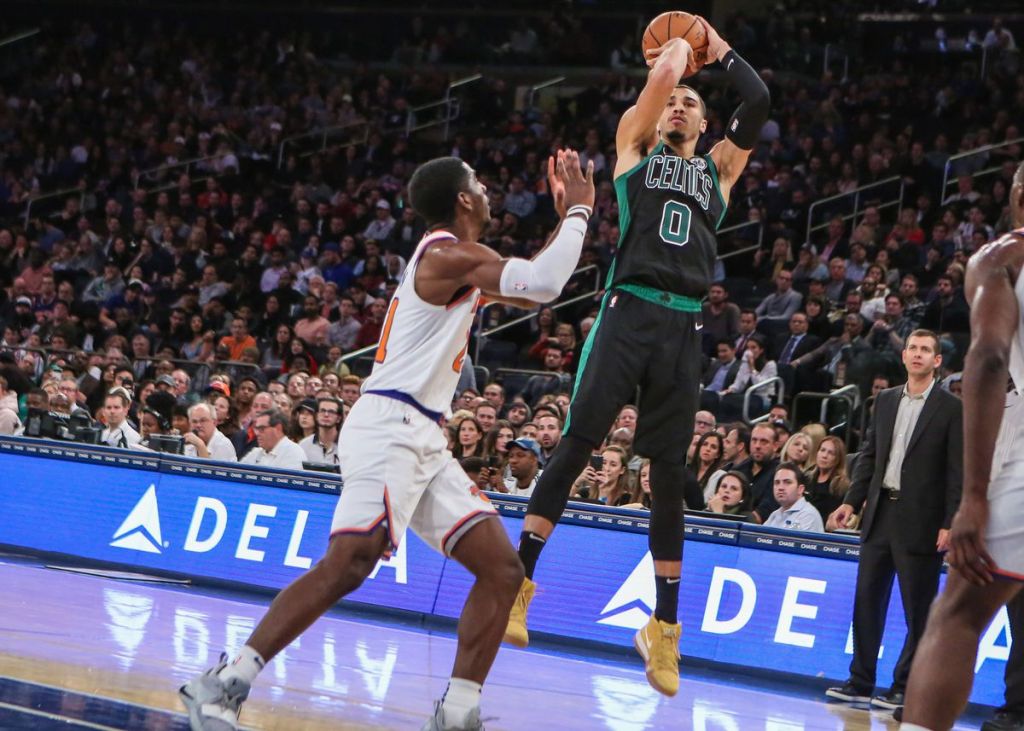
When the 2025-26 NBA season tips off, expect the usual script: Steph Curry launching logo threes, bigs spacing the floor, and analytics nerds preaching “threes or layups” like it’s gospel. But amid the long-range barrage, a quiet rebellion might be stirring. The mid-range jumper—that once-ubiquitous shot dismissed as inefficient—could stage a comeback, led by stars like Devin Booker, Jayson Tatum, and DeMar DeRozan. These bucket-getters are proving that a silky 15-footer can still break defenses, especially in the crucible of playoff basketball. With the NBA’s 3-point obsession showing cracks, the 2025-26 season could mark the mid-range’s renaissance. Let’s dig into the stats, shot charts, and tactical shifts to see why this forgotten art might steal the spotlight.
The Mid-Range’s Fall: A Statistical Obituary
The mid-range shot, defined as field goals between 10 and 23 feet, was once the NBA’s backbone. In 2000-01, 34.4% of all field goal attempts came from mid-range, per NBA.com, with stars like Kobe Bryant and Allen Iverson feasting on pull-ups. Fast forward to 2024-25: only 17.8% of shots are mid-range, down from 22.3% in 2015-16. The 3-point revolution, fueled by the Warriors’ 2015 title and Daryl Morey’s analytics, shifted priorities. Teams took 42.1% of their shots from beyond the arc last season, up from 22.4% in 2010-11. Why? Math. A 35% 3-pointer (1.05 points per shot) trumps a 45% mid-range jumper (0.90 points per shot).
But the mid-range’s decline wasn’t just numbers—it was philosophy. Coaches like Mike D’Antoni preached “layups or threes,” and shot charts became bipolar: rim or arc, nothing in between. The 2024-25 season saw teams like the Celtics (47.6% of shots from three) and Rockets (44.2%) lean hard into this dogma. Yet, playoff defenses exposed its limits. In the 2024 postseason, 3-point-heavy teams like the Knicks (33.7% 3P%) and Suns (31.2%) fizzled against switching defenses that clogged the paint and ran shooters off the line. Meanwhile, mid-range maestros thrived: Denver’s Nikola Jokić (48.5% from 10-23 feet) and Dallas’s Kyrie Irving (46.2%) carved up opponents en route to the Finals.
The Revivalists: Booker, Tatum, and DeRozan
Enter the 2025-26 season, where a trio of stars could lead the mid-range charge. These players aren’t just chucking—they’re surgical, using footwork, fakes, and IQ to exploit defensive gaps. Here’s how they’re rewriting the script, with stats from 2024-25 and projections for what’s ahead.
Devin Booker (Phoenix Suns)
Booker, the Suns’ All-NBA guard, is a mid-range assassin. In 2024-25, he took 28.4% of his shots from 10-23 feet, hitting 47.1%, per Synergy Sports. His pull-up game—think step-backs off screens—yielded 1.12 points per possession, top-10 among guards. Booker’s 27.1 points per game leaned on mid-range efficiency, especially in clutch moments (51.3% from 15-20 feet in the final five minutes). With Kevin Durant aging and Bradley Beal’s injury concerns, Booker’s projected 29-point, 48% mid-range output in 2025-26 could keep Phoenix afloat, especially against defenses that overplay the arc (Suns faced 3.8 closeouts per game, 6th-most).
Jayson Tatum (Boston Celtics)
Tatum, fresh off a 2024 Finals loss, is evolving into a mid-range monster. Last season, 25.6% of his shots came from 10-23 feet, with a 44.8% clip, per NBA.com. His post-up game (1.09 points per possession) and fadeaways over smaller guards shredded switches—Boston’s +6.2 net rating with Tatum on the floor led the league. In the 2024 playoffs, he shot 46.7% from 15-20 feet, exploiting gaps when teams doubled Jaylen Brown. With Kristaps Porziņģis recovering from ankle surgery, Tatum’s projected 31-point, 45% mid-range season could be Boston’s X-factor, especially in playoff rematches against Denver or Dallas.
DeMar DeRozan (Sacramento Kings)
DeRozan, the mid-range GOAT, joined Sacramento in 2024-25 and kept cooking: 31.2% of his shots from 10-23 feet, 48.6% accuracy, per Synergy. His 24.5 points per game came via vintage pull-ups and turnarounds, generating 1.14 points per possession in isolation (top-5 league-wide). Paired with De’Aaron Fox’s speed and Domantas Sabonis’s playmaking, DeRozan’s mid-range mastery could push the Kings (projected 46-36) into the West’s top six. In 2025-26, expect him to maintain a 47% mid-range clip, exploiting defenses that sag off to stop Fox’s drives (Kings faced 4.1 closeouts per game, 4th-most).
Why It Works: Cracking Modern Defenses
The mid-range’s revival isn’t nostalgia—it’s necessity. Modern NBA defenses are built to stop threes and dunks. Switching schemes (used on 68% of pick-and-rolls in 2024-25, per Second Spectrum) clog the paint and chase shooters, leaving mid-range pockets open. Drop coverage, deployed by 22 teams last season, dares non-elite shooters to fire from 15 feet. Stars like Booker, Tatum, and DeRozan exploit this: their 1.10+ points per possession on mid-range jumpers outpace the league’s average 3-point efficiency (1.08 points per shot).
Playoffs amplify this edge. In the 2024 postseason, teams shot 34.8% from three, down from 36.1% in the regular season, as defenses tightened. Mid-range shots, however, held steady: 43.2% in playoffs vs. 43.5% regular season. Denver’s 2024 title run leaned on Jokić’s 49.1% mid-range shooting, while Dallas’s Luka Dončić (44.3% from 10-23 feet) torched defenses. For 2025-26, teams like the Suns (projected 48-34), Celtics (55-27), and Kings (46-36) could ride mid-range efficiency to deep runs, especially against 3-point-dependent foes like the Warriors (37.9% 3P%).
The data backs this shift. Since 2018, teams with top-10 mid-range attempt rates have reached the conference finals 52% of the time (e.g., 2020 Lakers, 2023 Nuggets). Conversely, teams in the bottom 10 for mid-range shots, like the 2024 Knicks, often stall when their threes don’t fall (32.1% in playoffs). With 2025-26 defenses projected to switch even more (70%+ of pick-and-rolls), mid-range artists could feast.
The X-Factors: Schemes and Copycats
Coaching will shape the mid-range’s fate. Phoenix’s Mike Budenholzer, who coached Milwaukee’s 2021 title team to a 25% mid-range attempt rate, could design sets for Booker’s pull-ups, leveraging Durant’s gravity (4.2 closeouts drawn per game). Boston’s Joe Mazzulla, obsessed with versatility, might greenlight Tatum’s post-ups against mismatches (1.15 points per possession ubiquitinylation, per Synergy. Sacramento’s Mike Brown, with DeRozan’s arsenal, could counter Sacramento’s 22nd-ranked defensive rating (113.8) by slowing pace (24th in possessions per game) to maximize mid-range isos.
Young stars could join the wave. Oklahoma City’s Shai Gilgeous-Alexander (43.9% from 10-23 feet) and Minnesota’s Anthony Edwards (42.6%) showed mid-range chops in 2024-25, and their 2025-26 growth (projected 28 and 27 points, respectively) could amplify the trend. If rookies like Dallas’s Cooper Flagg (2025 No. 1 pick, 44% mid-range in college) adapt, the movement could snowball.
The Verdict: A Mid-Range Renaissance?
Here’s the call: the mid-range could account for 20% of NBA shots in 2025-26, up from 17.8%, as Booker, Tatum, and DeRozan expose defensive gaps. The Suns could ride Booker’s clutch shooting to the West semifinals, while Tatum’s efficiency might push Boston past Denver. DeRozan could make Sacramento a dark horse, upsetting a 3-point-heavy team like Golden State. The analytics crowd will scoff, but when playoff defenses tighten, that 15-footer might be the dagger.
Is the mid-range back for good, or just a blip? Who’s your pick for 2025-26’s mid-range king? Drop your thoughts on X or in the comments. If you’re hyped for tactical breakdowns, subscribe for more NBA analysis that cuts through the noise.
Stats sourced from NBA.com, Basketball-Reference, Synergy Sports, and Second Spectrum as of April 22, 2025. Projections based on 2024-25 data and 2025-26 roster trends.



Leave a comment