
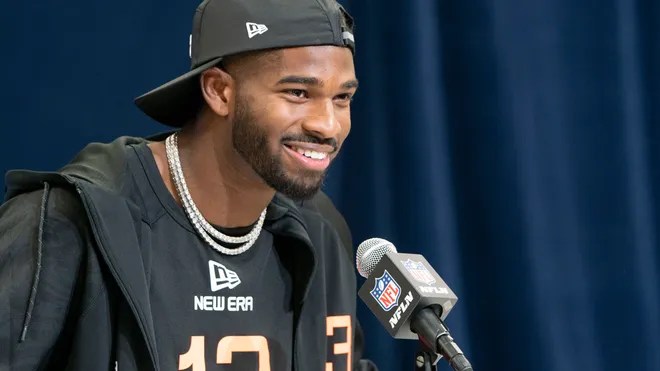
If you watched even a quarter of college football in 2024, you know Shedeur Sanders can sling the ball. The Colorado QB, son of Hall of Famer Deion Sanders, played with precision, poise, and behind arguably the worst offensive line in Division I. He racked up over 3,300 yards, 27 touchdowns, and only 3 interceptions—all while being sacked more than a clearance bin after Black Friday. Despite playing under duress every week, Sanders was a clear standout.
So when the 2025 NFL Draft came and went without his name being called in the first round, people started asking questions. Then the second round passed. And the third. When he was finally selected (by a team that hadn’t even expressed serious public interest), it felt… off. Quiet. Oddly synchronized. Some began to whisper about collusion.
Let’s be clear: there is no direct evidence. No leaked group chats. No shadowy backroom deals. But sometimes, the absence of noise is its own signal.
The Tape Doesn’t Lie
Shedeur’s production came not just from his natural talent but also his resilience. Behind an offensive line that surrendered 52 sacks, his ability to stay composed and avoid turnovers was remarkable. A 69.3% completion rate, over 3,300 passing yards, 27 touchdowns to just 3 interceptions—these aren’t pedestrian numbers. These are the stats of a quarterback with elite decision-making, footwork, and accuracy under pressure.
Compare him to other quarterbacks taken before him: many had more physical tools but fewer refined skills. They had more traditional size or combine metrics but nowhere near his command of the offense. Yet, they were called “toolsy,” “project QBs,” or “high-upside athletes.”
The NFL loves those words. They give teams permission to believe they can mold someone. But Shedeur? He didn’t need to be molded. That made him harder to own.
The Elephant in the Room Wears Sunglasses and a Whistle
Let’s talk about Deion Sanders. Prime Time. Coach Prime. Whatever name he goes by, one thing remains true: he doesn’t play by the old rules. And the NFL hates that.
Deion turned Jackson State into a spectacle. Then he took the media circus to Boulder. ESPN, Fox Sports, social media—they all followed. And so did the scrutiny. Every week was a headline. Every quote was a viral moment. And right in the middle of it all: Shedeur.
He was the calm center of the storm, rarely rattled, always composed. But in the eyes of NFL traditionalists, he became more than a player. He became a symbol. A brand. A movement. That doesn’t sit well with a league that still prefers its players to come in wide-eyed, humble, and grateful.
Shedeur wasn’t wide-eyed. He was aware.
NFL Teams Value Control
Control is the unspoken cornerstone of NFL management. The league thrives on hierarchy, on discipline, on players “buying in.”
When you draft a quarterback, you’re not just taking a player—you’re betting the future of your franchise on them. You want to mold them, mentor them, own the narrative. Shedeur’s presence complicates that. He already has a massive social media following. He already has brand deals. He’s the face of a new generation of athletes who don’t need the NFL to build their platforms.
That terrifies front offices.
The NFL is a machine built on consistency and control. The idea of a young quarterback with independent power, who can generate attention without the shield of the NFL logo, disrupts the balance. It shifts power dynamics. It forces a reckoning.
So when teams passed on him, it wasn’t about skill. It was about comfort.
The Language of Bias
Let’s dissect some of the scouting phrases thrown around in the weeks leading up to the draft:
- “Not a scheme fit”
- “Needs to improve decision-making”
- “Too focused on his brand”
- “Questionable leadership”
None of these criticisms had solid grounding. On film, Shedeur made elite-level reads. He kept his team in games they had no business being in. He absorbed hits, stayed in the pocket, and delivered strikes. He even served as an on-field coach at times, audibling protections and dissecting coverages.
So what do those criticisms really mean?
They’re dog whistles.
They’re how the league says: “He doesn’t fit the mold.”
It’s not that he isn’t a good player. It’s that he’s not the type of good player they want. One who knows his place. One who plays the game the way it’s always been played.
Historical Parallels
The NFL has a long history of uncomfortable relationships with Black quarterbacks who challenge convention.
Warren Moon had to go to Canada. Lamar Jackson had to answer questions about switching positions. Cam Newton was criticized for celebrating.
And when players speak out, speak up, or dare to be different, the league gets itchy.
Shedeur Sanders is not the first to face this kind of resistance. He’s just the latest iteration of a quarterback who makes executives uncomfortable because he brings more than just arm talent—he brings identity, voice, and autonomy.
The Draft Room Whisper Network
There are no official memos. No secret handshakes. But draft trends don’t lie. When a consensus emerges without a clear reason, you start to suspect a quiet consensus.
It might go something like this:
- “We love his game, but we’re worried about the distractions.”
- “Deion might be too involved.”
- “We don’t want to deal with the media circus.”
Those phrases get repeated behind closed doors. They get passed around, not as commandments, but as warnings. Enough repetition, and the warning becomes gospel.
That’s how collusion doesn’t have to be coordinated. It can be cultural.
What He Brings to the League
Ignore the drama. Ignore the narrative. Just look at what Shedeur Sanders offers:
- Elite pocket presence
- Fast mental processing
- A mature, NFL-ready arm
- Experience in hostile, high-pressure environments
- Natural leadership
He doesn’t just manage games; he elevates them. He has the tools to be a 10-year starter. Maybe more.
And now, with a chip the size of the Rockies on his shoulder, he’s going to play with something else the NFL didn’t want to give him: a point to prove.
Media Narratives Are Already Shifting
Since his selection, the coverage has changed. Suddenly, analysts are calling him a “steal.” They’re wondering aloud how he fell so far. Some even suggest the team that drafted him had him ranked higher than they let on.
Of course they did.
Nobody wants to admit they missed. And nobody wants to admit they were scared.
But Shedeur’s tape will speak. His performances will pile up. And when the wins come, the narrative will shift again. Then they’ll pretend they always believed.
What Comes Next
Shedeur will face pressure. He’ll be scrutinized every week. He’ll be expected to fail, to stumble, to become the cautionary tale everyone warned about.
And that’s when he’ll thrive.
Because Shedeur Sanders has been underestimated before. He watched teams ignore him out of high school. He followed his father to an HBCU and made national headlines. He transferred to a 1-11 Colorado team and turned it into a cultural moment.
The NFL isn’t the proving ground he needs. It’s just the next stage.
And for the executives who passed on him, it may become the biggest regret of their careers.
Final Thoughts
Call it coincidence. Call it caution. Just don’t pretend it wasn’t real.
There might never be a smoking gun. But the whisper network around Shedeur Sanders was louder than any cheer. It spoke in coded language, selective leaks, and tactical silence.
And it told a story the NFL didn’t want written:
A young Black quarterback, confident in his ability, secure in his identity, and unwilling to play by outdated rules, threatened the system more than any interception ever could.
He was the test.
The league blinked.
But the season hasn’t even started yet.
And Shedeur Sanders? He’s just warming up.



Leave a comment