
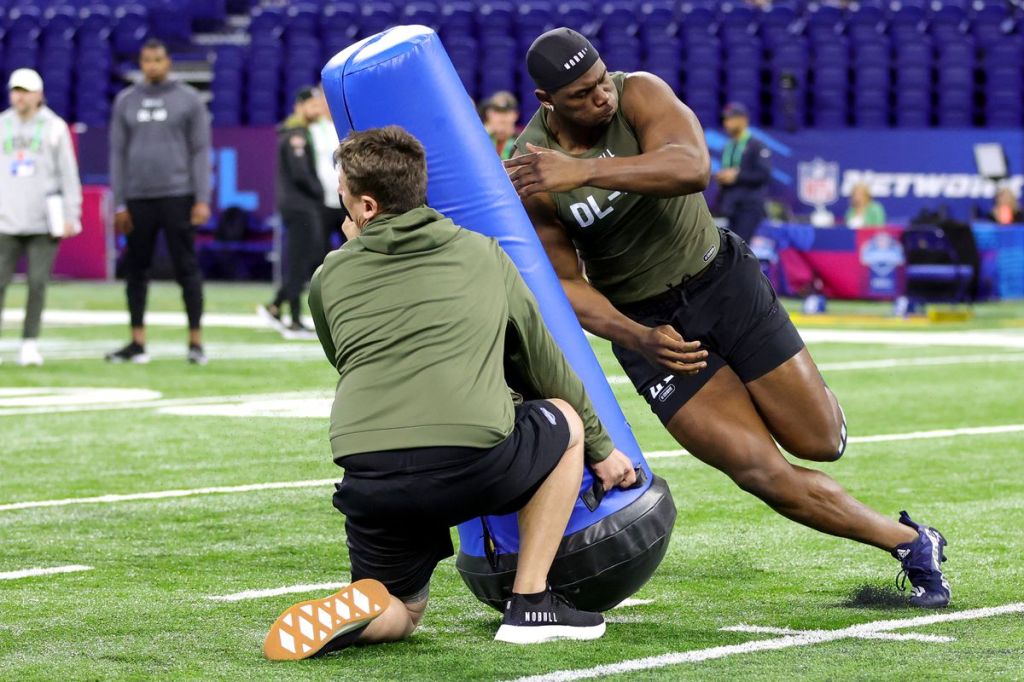
The NFL Draft has always been a high-stakes game of talent evaluation, where scouts, coaches, and front-office executives try to predict which college stars will shine on Sundays. For decades, the process has relied on a blend of art and science: hours of film study paired with hard data from the NFL Scouting Combine and college Pro Days. The 40-yard dash, bench press reps, vertical jumps, and shuttle drills have long been the measurable benchmarks that help teams assign grades to prospects. But something’s changing. More and more college players are opting out of these workouts, leaving scouts with incomplete stat sheets and forcing them to lean harder on the tape—and their gut. Is this a passing fad, or are we witnessing a shift back to an older, instincts-driven way of scouting? And more importantly, will it lead to more draft hits or a pileup of misses?
The Opt-Out Trend
It’s no secret that the Combine and Pro Days have become spectacles—part job interview, part athletic circus. Players train for months to shave tenths of a second off their 40 time or add an extra rep to their bench press, knowing these numbers can boost their draft stock. But in recent years, top prospects have started saying “thanks, but no thanks” to parts—or all—of these events. In 2025, we saw big names like Colorado’s Shedeur Sanders, Boise State’s Ashton Jeanty, and Penn State’s Abdul Carter skip on-field drills at the Combine, opting instead to showcase their skills at their Pro Days or not at all. Last year, five of the top six picks—including Caleb Williams and Marvin Harrison Jr.—did the same. This isn’t just a handful of outliers; it’s becoming a trend.Why are they doing it? For some, it’s about controlling the narrative. A subpar 40 time or a shaky three-cone drill could overshadow a stellar college career, especially for players already projected as first-round locks. Others, like those coming off deep playoff runs, cite the condensed training window—sometimes as little as three weeks—as insufficient to peak for the Combine’s specific tests. And then there’s the injury factor: why risk a tweaked hamstring in Indianapolis when your game film already screams “elite”?
The Scout’s Dilemma
This shift puts scouts and teams in a tough spot. The Combine and Pro Days were designed to standardize evaluations, giving every team the same data points to compare prospects head-to-head. A 4.4-second 40 or a 38-inch vertical isn’t just a number—it’s a piece of the puzzle that, when combined with film, helps build a player’s “full grade.” Without those metrics, evaluators are left with gaps. Sure, they’ve got height, weight, and arm length from medical checks, but the athletic testing? That’s a blank slate for some of the draft’s biggest names.In the past, a scout might’ve paired a player’s tape—say, a wide receiver’s knack for getting open deep—with a blazing 40 time to confirm his speed translates to the pros. Now, if that same receiver opts out, the scout’s left with just the tape and a hunch. It’s not that the data’s gone entirely—college GPS tracking and all-star games like the Senior Bowl offer some clues—but it’s less uniform, less controlled. Suddenly, the job of projecting a player’s NFL potential feels a lot more like it did in the pre-Combine days of the 1970s, when gut instinct and film ruled the roost.
Back to the Future: Film and Instincts
This isn’t necessarily a bad thing. After all, the draft has always been an inexact science. For every Combine star like Mike Mamula—who parlayed a monster 1995 performance into a top-10 pick but flamed out in the NFL—there’s a Terrell Suggs, whose sluggish 4.83 40 didn’t stop him from becoming a Ravens legend. The best scouts have always known that game film is king; the workouts are just confirmation. Now, with fewer players giving them those data points, teams are being forced to double down on what they see on tape. Is that cornerback’s backpedal as smooth as it looks? Does that quarterback’s pocket presence hold up under pressure? The answers aren’t in a stopwatch anymore—they’re in the hours of footage from Saturday afternoons.This return to film-first scouting could sharpen evaluators’ skills. Without the crutch of a shiny Combine stat line, they’ll need to trust their eyes and instincts more than ever. It’s a throwback to the days when the New York Jets pioneered pre-draft physicals in 1976, relying on interviews and medicals over standardized drills. Back then, hits like Joe Montana (a third-round “meh” athlete) and misses like Ryan Leaf (a workout warrior bust) came down to how well scouts read the intangibles. Today’s opt-out trend might just force modern evaluators to get better at their core job: finding football players, not track stars.
Hits, Misses, and the Big Unknown
Here’s the million-dollar question: will this shift improve draft outcomes? The jury’s still out. On one hand, leaning harder on film could cut through the noise of “workout warriors”—those players who dominate drills but flop in pads. Look at John Ross, whose record-breaking 4.22 40 in 2017 vaulted him to the ninth overall pick, only for injuries and inconsistency to derail his career. Fewer metrics might mean fewer overhyped busts. On the flip side, without those numbers to confirm or contradict the tape, scouts might miss red flags—like a lineman’s lack of agility or a receiver’s subpar burst—that only show up in testing.The draft has always been a crapshoot. Even with full Combine data, teams hit on about 50% of first-round picks (depending on how you define “hit”). Going back to an older, less data-driven approach could refine that hit rate if scouts adapt—or it could amplify the chaos if they lean too hard on gut calls gone wrong. What’s clear is that this trend isn’t slowing down. As players gain more agency in the pre-draft process, opting out could become the norm for top-tier talents, leaving the Combine and Pro Days as proving grounds for mid-round sleepers and small-school gems.
What’s Next?
We won’t know the full impact until years down the line, when the 2025 class has had time to prove itself. Will the teams that ace this year’s tape-heavy evaluations—like whoever snags a gem without a 40 time—set a new standard? Or will the lack of data lead to more whiffs, pushing the NFL to rethink how it tests prospects? One thing’s for sure: the scouts who thrive in this new reality will be the ones who can blend the old-school art of film study with a keen eye for the intangibles. The Combine’s not dead yet, but its grip on the draft is loosening—and that might just make the process more human, for better or worse.What do you think? Are opt-outs a smart move for players, or a headache for teams? Drop your take in the comments—I’d love to hear where you land on this.



Leave a comment